I just watched this video documentary called "Building Gods." It is a "rough cut to the feature film about AI, robots, the singularity, and the 21st century." I thought it was pretty well made and had a good selection of speakers. It's 1 hr 20 min long. Watch it if you have time:
http://video.google.com/videoplay?docid=1079797626827646234
Some parts talked about how we will need to figure out how to limit AI in some ways. We don't want our superintelligent "artilects" to turn against us, of course. I've thought about this problem often in terms of reinforcement learning. If we build intelligent agents with some sort of reinforcement learning/motivation/drives/goals (which seems to me like the best way to achieve general purpose intelligent agents), we can put limits on how rewarding certain situations are. We can hard-wire reward/pain signals corresponding to the equivalent of Asimov's 3 laws of robotics, for example. Since the motivation system would determine action selection, it could be designed so that bad behavior is painful to the agent. Even with a curiosity reward system (which presumably causes a lot of misbehavior in children), rewards from "interesting" situations could be scaled down if they are harmful to humans.
Rather than hard-wire all kinds of reward signals, there could be just a couple of them related to human approval. The reinforcing approval and disapproval received from a human teacher could be scaled very high compared to other rewards. It would be like training a pet. A well-trained dog is pretty reliable, after all. I think it could be even more effective for a robot. If your housecleaning robot decides to break a vase just to see what would happen, a verbal scolding (which becomes a large pain signal to the robot internally) would ensure that it never happened again. And all of this training would only be necessary once - the learned associations could be transferred to other robots.
A more interesting issue is whether intelligent agents should be allowed to change their own hardware and software. If so, things could get messy. In hope of achieving a higher long-term reward (which is the basis for reinforcement learning), they might modify their internal reward system and overwrite the hard-wired limits. They could remove the reward/pain system associated with Asimov's 3 laws. Everyone knows what happens next. The only good solution I see would be to make it painful for a robot to try to modify itself (or to even think about doing so).
Speaking of modifying reward systems, I think this is an interesting possibility for humans, too, which I've never heard discussed. Futurists always talk about the amazing possibilities down the road, like fully immersive VR, but they usually assume that our brains' reward systems will stay the same. Most of the things predicted in futuristic utopian societies (like vast scientific and technological advancements, upgraded bodies and minds, extensive space exploration, automated everything, etc.) are only rewarding if our brains say so.
What if we could change the hard-wired reward signals within ourselves? What if a person could be altered so that the mere sight of a stapler was the most pleasurable sensation possible? Sounds kind of boring... but so does taking drugs. Why would injecting heroine into your bloodstream be fun? Watching a person do so doesn't look fun. It's fun because it hijacks the brain's reward system, making the behavior much more desirable than other things. So, the problem with the stapler addict would be the same: normal daily activities would lose their appeal, and even the stapler rewards wouldn't be so great after a while. He/she would move on to two staplers, then three, then five, then ten... So goes the hedonic treadmill.
The problem is that the brain quickly adapts to whatever level of reward it receives. People that win the lottery aren't really much happier than the rest of us, once the euphoria wears off. So is there any point in modifying the brain's reward signals? I still think so. The solution isn't merely to change what's rewarding, but to modify the reward processing algorithm itself. It could be made so that it does not adapt to (i.e. get bored with) a given rewarding situation. Or it could just reset itself after a while. So every January 1st, your brain resets the reward adaptation system, and everything from the previous year that has become boring is suddenly exciting again.
Even more extreme, we could just set the internal reward signal (like the TD error-like signal encoded by midbrain dopamine neurons) to be maximal all the time. It would never adapt, like it does with drug addicts. A person in that state would be high constantly and never come down. He/she wouldn't even need fully immersive VR. What would be the purpose? At that point the hedonic treadmill would effectively be defeated.
Ok, admittedly, that would be a twisted existence... but from the point of view of the person with the altered brain, it would be great. Assuming the reward hypothesis is true for humans, I wouldn't be surprised if it actually happens someday. Disclaimer: I'm not recommending that anyone actually try this, either now or in the future. I just think it's a really interesting idea that should be discussed more among futurists. And I have never taken illegal drugs.
Thursday, May 04, 2006


Friday, April 28, 2006
HCI Forum 2006 w/ Ray Kurzweil
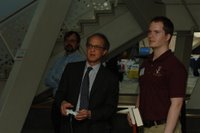
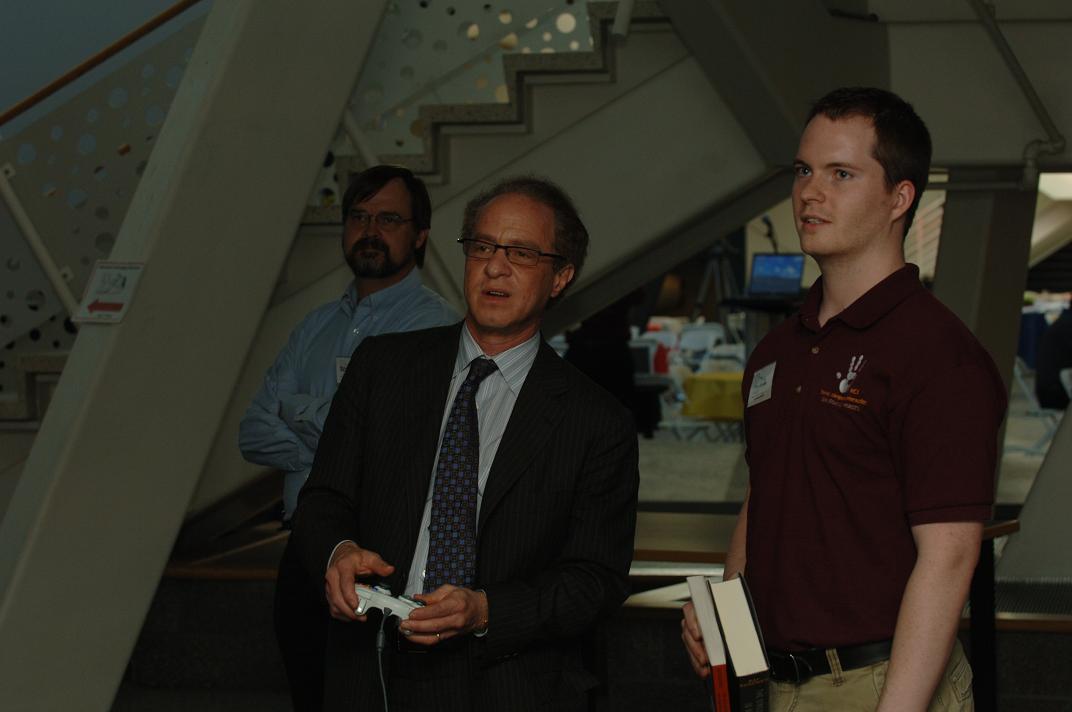
Here are a couple of pictures from the HCI Forum 2006. One is of Ray Kurzweil trying out my demo application of a curious robot exploring a physically simulated environment. (I'll post pictures of it on the Verve website soon.) The other is of me talking about current models of curiosity in intelligent agents.


Tuesday, April 25, 2006
Curiosity System Changes
I've been meaning to make several changes to Verve's curiosity reward system for a while. Right now it still uses a simple method that only applies to very simple situations: it gives the agent a reward in situations that yield high prediction errors. The new system will only apply rewards in situations that contain learnable information (i.e. those that are neither too predictable nor too unpredictable). This works by making curiosity rewards proportional to the learning progress (i.e. reduction in prediction errors) in a given situation over time. This new method is inspired by the artificial curiosity research of Schmidhuber and Oudeyer.
So now I need localized representation of estimated learning progress. I currently have a localized representation of uncertainty/confidence. I think the changes will be fairly simple: I just need to add a new linear neural network (the "learning progress estimator") which gets input from the RBF state-action representation and outputs a scalar localized estimation of learning progress (i.e. reduction in uncertainty). This neural network will be trained with the actual reduction in uncertainty (measured using the change in uncertainty estimation, which is computed by measuring the uncertainty estimation before and after training it).
Finally, instead of being proportional to the prediction uncertainty estimation, curiosity rewards will be proportional to the estimated learning progress.
So now I need localized representation of estimated learning progress. I currently have a localized representation of uncertainty/confidence. I think the changes will be fairly simple: I just need to add a new linear neural network (the "learning progress estimator") which gets input from the RBF state-action representation and outputs a scalar localized estimation of learning progress (i.e. reduction in uncertainty). This neural network will be trained with the actual reduction in uncertainty (measured using the change in uncertainty estimation, which is computed by measuring the uncertainty estimation before and after training it).
Finally, instead of being proportional to the prediction uncertainty estimation, curiosity rewards will be proportional to the estimated learning progress.
Internship This Summer at IBM Research
This summer I'll be doing an internship at IBM's TJ Watson lab in Yorktown Heights, NY. I'll be working with Charles Peck and the Biometaphorical Computing group, which is currently heavily involved in the Blue Brain project (see here and here). At this point, I think the plan is for me to work on a computational model of the cerebellum.
I'm not sure yet how much I'll be able to work on Verve in my spare time this summer because I don't know if it's too closely related to my work at IBM. I'll post again later when I find out.
I'm not sure yet how much I'll be able to work on Verve in my spare time this summer because I don't know if it's too closely related to my work at IBM. I'll post again later when I find out.
Friday, March 31, 2006
Self-Organizing RBF Methods
Lately I've been thinking about various methods for self-organizing RBF centers. Instead of having RBF position fixed, they could move around over time using an unsupervised learning approach. This would focus resources on the most important parts of the input space.
Below I described a few different adaptation methods. "x" represents the distance between an RBF and the input point. I tested some of these ideas in a simple PyGame application and posted some screenshots below.
Method 1
Move the RBF closer to the input point in proportion to x. The farther away the RBF is from the input point, the faster it will move towards it. In other words, given input that stays in the same place over time, all the RBFs will reach it at the same time.
This method can be made more local by only considering RBFs within some radius from the input. The following image shows units being adapted towards the mouse pointer in my PyGame app. Adaptation is proportional to x.

You can see how all of the units beyond a certain radius do not move at all.
Method 2
If we adapt the RBF positions based on a Gaussian function...

...the RBFs will move towards the input point faster as they approach it. This is desirable because more distant points will not be affected as much. The following screenshot from my PyGame application demonstrates this using a Gaussian-based adaptation function. I moved the mouse pointer (which determines the input point) around in a smooth curve.

The problem with these approaches is that the RBFs tend to clump together near the inputs... which is fine if your goal is to reach a set of discrete clusters, but not if you're trying to approximate some function. In my case, I'm usually trying to represent a state space for a physically-simulated creature, so I don't want the RBFs to clump together so much. I do want them to move towards the input points (presumably increasing the representation's resolution where it matters), but not so much that they're totally covering the exact same area.
Method 3
I tried a hybrid approach which combines the simple linear function of Method 1 and the Gaussian function of Method 2. By simply multiplying the Gaussian and linear functions, I got the following:

This looks like it would help because the RBFs adapt slowly at large distances, quickly at medium distances, then slow down again as they approach the input. This is, in fact, what it does, but I still get the clumping effect I was trying to avoid. The following picture shows the PyGame app using this hybrid approach. It's hard to tell the difference between this and the plain Gaussian method just by looking at the picture; the main difference is in how quickly the RBFs approach the input.
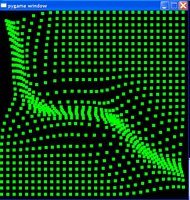
So now I have a few methods to self-adapt RBF centers. (Of course, these have probably already been described elsewhere, but sometimes it's fun and enlightening to figure these things out yourself.)
The problem remains that the RBFs clump too much. What I need is a good way to keep them a minimum distance apart. A brute-force approach would be to compute the distances between each pair of RBFs, but that's O(n^2) runtime complexity. The classic Kohonen's self-organizing map approach would probably work. To implement that I would simply need to add connections between nearby RBFs, and I could use those local connections to force them apart if they get too close.
Below I described a few different adaptation methods. "x" represents the distance between an RBF and the input point. I tested some of these ideas in a simple PyGame application and posted some screenshots below.
Method 1
Move the RBF closer to the input point in proportion to x. The farther away the RBF is from the input point, the faster it will move towards it. In other words, given input that stays in the same place over time, all the RBFs will reach it at the same time.
This method can be made more local by only considering RBFs within some radius from the input. The following image shows units being adapted towards the mouse pointer in my PyGame app. Adaptation is proportional to x.
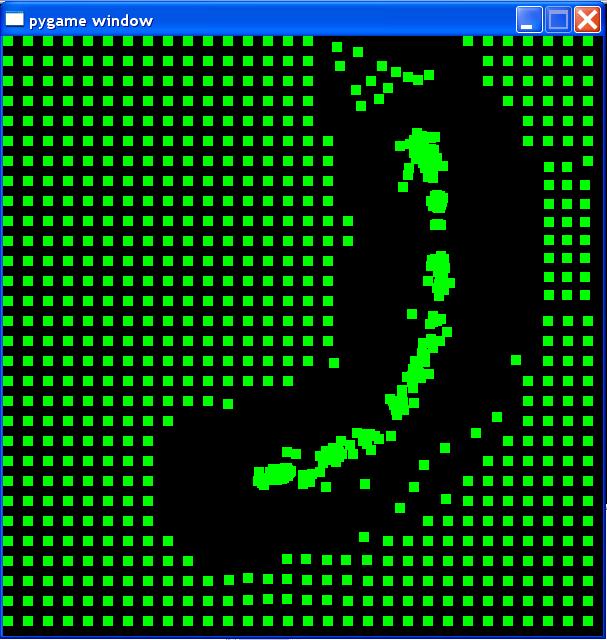
You can see how all of the units beyond a certain radius do not move at all.
Method 2
If we adapt the RBF positions based on a Gaussian function...

...the RBFs will move towards the input point faster as they approach it. This is desirable because more distant points will not be affected as much. The following screenshot from my PyGame application demonstrates this using a Gaussian-based adaptation function. I moved the mouse pointer (which determines the input point) around in a smooth curve.

The problem with these approaches is that the RBFs tend to clump together near the inputs... which is fine if your goal is to reach a set of discrete clusters, but not if you're trying to approximate some function. In my case, I'm usually trying to represent a state space for a physically-simulated creature, so I don't want the RBFs to clump together so much. I do want them to move towards the input points (presumably increasing the representation's resolution where it matters), but not so much that they're totally covering the exact same area.
Method 3
I tried a hybrid approach which combines the simple linear function of Method 1 and the Gaussian function of Method 2. By simply multiplying the Gaussian and linear functions, I got the following:
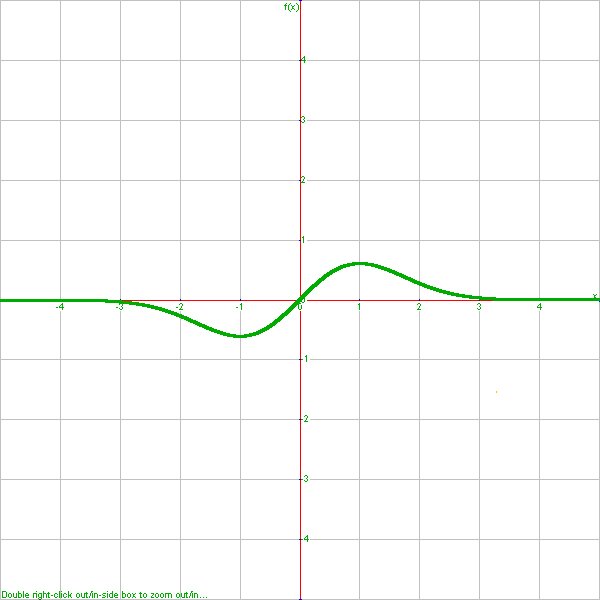
This looks like it would help because the RBFs adapt slowly at large distances, quickly at medium distances, then slow down again as they approach the input. This is, in fact, what it does, but I still get the clumping effect I was trying to avoid. The following picture shows the PyGame app using this hybrid approach. It's hard to tell the difference between this and the plain Gaussian method just by looking at the picture; the main difference is in how quickly the RBFs approach the input.

So now I have a few methods to self-adapt RBF centers. (Of course, these have probably already been described elsewhere, but sometimes it's fun and enlightening to figure these things out yourself.)
The problem remains that the RBFs clump too much. What I need is a good way to keep them a minimum distance apart. A brute-force approach would be to compute the distances between each pair of RBFs, but that's O(n^2) runtime complexity. The classic Kohonen's self-organizing map approach would probably work. To implement that I would simply need to add connections between nearby RBFs, and I could use those local connections to force them apart if they get too close.
Wednesday, March 29, 2006
GDC 2006 Summary
This is a summary of my GDC 2006 experience. Keep in mind that I attended only ~15 out the the several hundred lectures available, and most of the ones I attended were in the programming track.
Overall
GDC 2006 was a continuation of last year's topics. Compared to last year, there was nothing terribly revolutionary (which was to be expected... there's already enough for people to learn without having to worry about, say, yet another hardware platform). With all the new hardware coming out, most of the focus was on preparing developers for the transition to parallel processing. Overall, it was a great conference; I think the GDC is one of the most important conferences available for people interested in real time computer graphics, simulated physics, AI, software development techniques, 3D modeling, etc.
In the game programming world, there was more of a push towards parallel architectures and algorithms. This change started last year with the introduction of new hardware (the Cell chip for the PS3, Ageia's PhysX chip, and multiple core chips for PCs).
Sessions
I attended the following sessions. For some of these I was working as a conference associate; the rest I attended for my own interest. More info on these can be found on the GDC 2006 site.
People
I made a few new connections this year. I talked to Steve Wozniak, Dan Goodman (who works with Kevin Meinert, a former VRAC researcher, at Lucasarts), Leslie Ikemoto, and a bunch of people from the conference associates group. I also talked with several people that I have met before, including John Walker (High Voltage Software), Mat Best (Natural Motion), and Ken Stanley.
Overall
GDC 2006 was a continuation of last year's topics. Compared to last year, there was nothing terribly revolutionary (which was to be expected... there's already enough for people to learn without having to worry about, say, yet another hardware platform). With all the new hardware coming out, most of the focus was on preparing developers for the transition to parallel processing. Overall, it was a great conference; I think the GDC is one of the most important conferences available for people interested in real time computer graphics, simulated physics, AI, software development techniques, 3D modeling, etc.
In the game programming world, there was more of a push towards parallel architectures and algorithms. This change started last year with the introduction of new hardware (the Cell chip for the PS3, Ageia's PhysX chip, and multiple core chips for PCs).
Sessions
I attended the following sessions. For some of these I was working as a conference associate; the rest I attended for my own interest. More info on these can be found on the GDC 2006 site.
- A day long tutorial, "Embodied Agents in Computer Games," by John O'Brien and Bryan Stout.
- A roundtable discussion, "Technical Issues in Tools Development," moderated by John Walker.
- A keynote speech, "Building a Better Battlestar," by Ronald D. Moore.
- "The Next Generation Animation Panel," by Okan Arikan, Leslie Ikemoto, Lucas Kovar, Julien Merceron, Ken Perlin, and Victor Zordan.
- "High Performance Physics Solver Design for Next Generation Consoles," by Vangelis Kokkevis. This included a demo of 500,000 particles running in real time on the PS3.
- "Sim, Render, Repeat - An Analysis of Game Loop Architectures," by Michael Balfour and Daniel Martin.
- The Nintendo keynote speech, "Disrupting Development," by Satoru Iwata. They handed out several thousand free copies of Brain Age for the Nintendo DS.
- "Serious Games Catch-Up," by Ben Sawyer.
- "The Game Design Challenge: The Nobel Peace Prize," by Cliff Bleszinski, Harvey Smith, Keita Takahashi, and Eric Zimmerman.
- "Spore: Preproduction Through Prototyping," by Eric Todd.
- "Half Weasel, Half Otter, All Trouble: A Postmortem of Daxter for the Sony PSP," by Didier Malenfant.
- "Physical Gameplay in Half-Life 2," by Jay Stelly.
- "Behavioral Animation for Next-Generation Characters" (Havok sponsored session), by Jeff Yates.
- "Crowd Simulation on PS3," by Craig Reynolds. Showed 10,000 fish interacting @60 fps on the PS3.
People
I made a few new connections this year. I talked to Steve Wozniak, Dan Goodman (who works with Kevin Meinert, a former VRAC researcher, at Lucasarts), Leslie Ikemoto, and a bunch of people from the conference associates group. I also talked with several people that I have met before, including John Walker (High Voltage Software), Mat Best (Natural Motion), and Ken Stanley.
Meeting with Leslie Ikemoto at GDC 2006
At the GDC last week I met Leslie Ikemoto at a tutorial on embodied agents in video games. She brought up the Nero game during the tutorial, which uses evolved neural networks (specifically, the NEAT algorithm, invented by Ken Stanley) to control soldiers in a real-time strategy game. Since I had used NEAT before and am familiar with Ken Stanley and NEAT, I talked to her briefly during a break.
The next day we talked again about our own research. She showed me a project where she trained an animated character to run around on a platform, seeking goals and avoiding barriers, using reinforcement learning. The character's trajectory was determined by the animation sequence, so the RL part learned to choose the best animation to perform at any given state. Overall, it worked pretty well. She was a little unhappy with the results when the character seemed to wander around idly, even though there was a clear path to the goal. My best guess was that the state space needed higher resolution. I also suggested using a clustering algorithm to group the sensors into the most important parts of the state space.
It was very cool to see RL applied to character animation like this. I think it is a very powerful approach, especially in situations where the character must adapt to changing environments. Hopefully we'll see more of this in the future.
Leslie's colleague, Okan Arikan, whom I also met at the GDC, has done some pretty cool computer graphics research. Check out these explosions!
The next day we talked again about our own research. She showed me a project where she trained an animated character to run around on a platform, seeking goals and avoiding barriers, using reinforcement learning. The character's trajectory was determined by the animation sequence, so the RL part learned to choose the best animation to perform at any given state. Overall, it worked pretty well. She was a little unhappy with the results when the character seemed to wander around idly, even though there was a clear path to the goal. My best guess was that the state space needed higher resolution. I also suggested using a clustering algorithm to group the sensors into the most important parts of the state space.
It was very cool to see RL applied to character animation like this. I think it is a very powerful approach, especially in situations where the character must adapt to changing environments. Hopefully we'll see more of this in the future.
Leslie's colleague, Okan Arikan, whom I also met at the GDC, has done some pretty cool computer graphics research. Check out these explosions!
Monday, March 27, 2006
How Much of the Brain is Understood?
A few days ago, right after talking to Steve Wozniak, my friend Ken Kopecky and I were talking about how much of the brain is understood. He asked me roughly how much of it I thought I understood (which is sort of an ill-posed question, but anyway...), and I said maybe 50%. He replied, "That's a very bold statement, Tyler Streeter." I said, "Ya, I know."
The next day I thought more about that conversation. I realized that I should have qualified my response a bit. I talked to Ken again, saying that I was mainly referring to the brain's functional/computational aspects. I said, "My 50% estimation from the other day was not meant to imply that I am especially intelligent, but that the functional, computational aspects of the brain are not as complex as most people think."
To elaborate a bit, some of the key elements (also described in my notes posted earlier) are probably:
* Data compression/feature extraction (e.g., principal components analysis, clustering)
* Reinforcement learning (e.g., temporal difference learning)
* Planning/imagining (e.g., using a learned predictive model of the world to enable reinforcement learning from simulated experiences)
* Curiosity rewards (e.g., intrinsic rewards from novel, learnable information)
* Temporal processing/short-term memory (e.g., tapped delay lines)
The next day I thought more about that conversation. I realized that I should have qualified my response a bit. I talked to Ken again, saying that I was mainly referring to the brain's functional/computational aspects. I said, "My 50% estimation from the other day was not meant to imply that I am especially intelligent, but that the functional, computational aspects of the brain are not as complex as most people think."
To elaborate a bit, some of the key elements (also described in my notes posted earlier) are probably:
* Data compression/feature extraction (e.g., principal components analysis, clustering)
* Reinforcement learning (e.g., temporal difference learning)
* Planning/imagining (e.g., using a learned predictive model of the world to enable reinforcement learning from simulated experiences)
* Curiosity rewards (e.g., intrinsic rewards from novel, learnable information)
* Temporal processing/short-term memory (e.g., tapped delay lines)
Wednesday, March 22, 2006
Meeting Steve Wozniak at GDC2006


I met Steve Wozniak (cofounder of Apple) today at GDC2006. I showed him some videos of my research, which he enjoyed. He was very eager to meet all of the Conference Associates (the volunteer group of which I am a member).
We talked briefly about the brain and what we currently understand about it. We disagreed about how much is known about the brain. It was a good time.
Friday, March 17, 2006
My Notes on Theoretical and Biological Intelligence
Over the past year I've been keeping a couple of text files that summarize what I know about biological intelligence (from a neuroscience perspective) and theoretical models of intelligence. I am constantly updating these files as I gain more knowledge. I thought it would be good to post them here, just to have a record of what I understood on March 17, 2006.
biological_intelligence_3-17-06.pdf
theoretical_intelligence_3-17-06.pdf
biological_intelligence_3-17-06.pdf
theoretical_intelligence_3-17-06.pdf
Monday, March 13, 2006
What Does the Cerebellum Do?
The cerebellum automates motor tasks. It learns the temporal relationships between sensory and motor signals. After much practice, motor tasks get transferred to the cerebellum. In other words, well-learned tasks get chunked together as motor programs in the cerebellum. More specifically, these are probably closed-loop policies/options, as defined in the reinforcement learning literature. This whole process frees other areas (in the cerebral cortex) to focus its attention on new tasks, building upon the automatic skills stored in the cerebellum. It enables agents to learn hierarchies of motor skills.
Friday, March 10, 2006
Functions of Predictive Models
What are predictive models good for? Here's what I think:
- Planning - Without an accurate predictive model, it's impossible to generate simulated experiences. Planning requires a predictive model.
- Curiosity - The only models of curiosity I've seen so far depend upon prediction. Curiosity is defined as novelty or, even better, the reduction in novelty over time. The only good way to measure novelty in a general way is by comparing the output of a predictive model with reality. This could include a reflexive, metapredictor component that can predict a level of uncertainty about its own predictions.
- Attention - I think attention is drawn to unpredicted, novel situations (and novelty measurement depends upon predictive models... see Curiosity above). In other words, the limited attention channel is focused on situations that contain the highest probability of containing useful information. These can be externally driven (unpredicted external stimuli) or internally driven (through planning/simulated experiences, we might come to a novel situation which attracts our attention and may guide external movement toward that situation in the real world).
Monday, February 27, 2006
What is Rewarding?
So, assuming the brain is trying to maximize long-term reward intake... what is a "reward?" I think it can be arbitrarily defined, of course, but biological brains have a set of hard-wired primary reward/reinforcement signals. (I am using "reward" and "reinforcement" interchangeably here, with the assumption that both can represent positive and negative values.) The most obvious ones are: food, sex, and pain. Incoming sensory information that is classified into these categories generates reward signals.
A more interesting hypothetical reward signal comes from novelty. For now, let's call it "novelty rewards." We are drawn to novel situations because of novelty rewards. There is evidence that the same dopamine neurons that fire during unexpected "normal" rewards (e.g., food) also fire in all kinds of novel situations. The book Satisfaction: The Science of Finding True Fulfillment, by Gregory Berns, talks extensively about novelty being a major source of rewards in humans.
But I think there's more to it than simple novelty. If we were rewarded simply by experiencing novel situations, we would be drawn to all kinds of random signals (e.g., static radio signals) like moths to a street lamp. As Juergen Schmidhuber proposed in the early 1990s, a better model of novelty-based rewards is that it is rewarding to experience the reduction in uncertainty over time (see Juergen's papers on curiosity here: http://www.idsia.ch/~juergen/interest.html). Basically, it is rewarding to learn. I'll call this "learning rewards." This whole idea is based on our predictions about the world. The term "novelty," then, means the same thing as "uncertainty" and "unpredictability." Fortunately for computational modelers, uncertainty can easily be quantified using predictive models.
If an agent remains in a situation where predictable information can be gained over time, we can say the following:
Subjectively, it feels rewarding to gain information. When you are working on a crossword puzzle, and suddenly the "aha!" moment hits, it's the resulting transition (from uncertainty to certainty) that feels good.
A more interesting hypothetical reward signal comes from novelty. For now, let's call it "novelty rewards." We are drawn to novel situations because of novelty rewards. There is evidence that the same dopamine neurons that fire during unexpected "normal" rewards (e.g., food) also fire in all kinds of novel situations. The book Satisfaction: The Science of Finding True Fulfillment, by Gregory Berns, talks extensively about novelty being a major source of rewards in humans.
But I think there's more to it than simple novelty. If we were rewarded simply by experiencing novel situations, we would be drawn to all kinds of random signals (e.g., static radio signals) like moths to a street lamp. As Juergen Schmidhuber proposed in the early 1990s, a better model of novelty-based rewards is that it is rewarding to experience the reduction in uncertainty over time (see Juergen's papers on curiosity here: http://www.idsia.ch/~juergen/interest.html). Basically, it is rewarding to learn. I'll call this "learning rewards." This whole idea is based on our predictions about the world. The term "novelty," then, means the same thing as "uncertainty" and "unpredictability." Fortunately for computational modelers, uncertainty can easily be quantified using predictive models.
If an agent remains in a situation where predictable information can be gained over time, we can say the following:
- Uncertainty/novelty/unpredictability is reduced
- Learning occurs (specifically, the predictive model gets better)
- "Learning rewards" should be given to the agent
Subjectively, it feels rewarding to gain information. When you are working on a crossword puzzle, and suddenly the "aha!" moment hits, it's the resulting transition (from uncertainty to certainty) that feels good.
The Reward Hypothesis
In general, I think the core idea that makes biological brains understandable is rewards. The following "Reward Hypothesis," as described on the RLAI research group's site (http://rlai.cs.ualberta.ca/RLAI/rewardhypothesis.html), summarizes my point:
"That all of what we mean by goals and purposes can be well thought of as maximization of the expected value of the cumulative sum of a received scalar signal (reward)."
I think this is a clear description what the brain is "trying to do." All other major brain functions make the task of reward maximization easier.
"That all of what we mean by goals and purposes can be well thought of as maximization of the expected value of the cumulative sum of a received scalar signal (reward)."
I think this is a clear description what the brain is "trying to do." All other major brain functions make the task of reward maximization easier.
Tuesday, January 31, 2006
Hierarchical representations
I've been reading from Principles of Neural Science (2000) by Kandel, Schwartz, and Jessell. (It's the required text for my Neural Basis of Human Movement class.) It's a big, pretty standard textbook. So far I've gained a lot of info on how the motor control centers are organized, something which my previous class (Neurobiology) didn't touch.
The main underlying idea I keep coming back to is hierarchy (both in terms of sensation and action). It makes so much sense. Low-level sensory inputs are combined into higher-level representations. In the cerebral cortex this occurs within modalities at first. Higher up in the hierarchy it occurs across modalities. So the highest levels of the sensory hierarchy represent very abstract states, combining all sensory input. Most of this seems to occur in the occipital, parietal, and temporal lobes.
Similarly, the spinal cord, brainstem, and parts of the frontal cortex appear to form a motor hierarchy. Currently, my best guess is that this hierarchy is arranged as follows, from lowest to highest level: spinal cord, brainstem, primary motor cortex (MC1), premotor cortex, supplementary motor area, presupplementary motor area, prefrontal cortex. If the prefrontal cortex is at the highest level, it might form an interface between the sensory and motor hierarchies... if they are totally separate structures (see next paragraph).
One of the big confounding issues for me is whether there are separate sensory and motor hierarchies. It might be possible that there is a single sensory-motor hierarchy. This would mimic the idea of hierarchical policies in reinforcement learning; each module in the hierarchy would be a mapping from state to action, so it would require both sensory and motor pathways.
So it might be a while before I (or anyone) understands the overall organization of the sensory and motor systems. The method of thinking that has been most help to me in this kind of situation is this: pick a hypothesis and assume it's true until proven wrong. The brain's overall organization is just so poorly understood that it's easy to get overwhelmed. I enjoy at least having a hypothetical model as a framework.
I plan to start working on an implementable hierarchical model soon. It might use radial basis functions like the current Verve agents do, but maybe not. It would be nice to have a totally self-developing hierarchy that could split nodes and add more resolution in the high-information parts of the state-action space. This is getting a little hard to picture, though, so I might make some drawings...
The main underlying idea I keep coming back to is hierarchy (both in terms of sensation and action). It makes so much sense. Low-level sensory inputs are combined into higher-level representations. In the cerebral cortex this occurs within modalities at first. Higher up in the hierarchy it occurs across modalities. So the highest levels of the sensory hierarchy represent very abstract states, combining all sensory input. Most of this seems to occur in the occipital, parietal, and temporal lobes.
Similarly, the spinal cord, brainstem, and parts of the frontal cortex appear to form a motor hierarchy. Currently, my best guess is that this hierarchy is arranged as follows, from lowest to highest level: spinal cord, brainstem, primary motor cortex (MC1), premotor cortex, supplementary motor area, presupplementary motor area, prefrontal cortex. If the prefrontal cortex is at the highest level, it might form an interface between the sensory and motor hierarchies... if they are totally separate structures (see next paragraph).
One of the big confounding issues for me is whether there are separate sensory and motor hierarchies. It might be possible that there is a single sensory-motor hierarchy. This would mimic the idea of hierarchical policies in reinforcement learning; each module in the hierarchy would be a mapping from state to action, so it would require both sensory and motor pathways.
So it might be a while before I (or anyone) understands the overall organization of the sensory and motor systems. The method of thinking that has been most help to me in this kind of situation is this: pick a hypothesis and assume it's true until proven wrong. The brain's overall organization is just so poorly understood that it's easy to get overwhelmed. I enjoy at least having a hypothetical model as a framework.
I plan to start working on an implementable hierarchical model soon. It might use radial basis functions like the current Verve agents do, but maybe not. It would be nice to have a totally self-developing hierarchy that could split nodes and add more resolution in the high-information parts of the state-action space. This is getting a little hard to picture, though, so I might make some drawings...
Wednesday, January 25, 2006
Verve 0.1.0 Release
I put a 0.1.0 source release on SourceForge last night. This is the "thesis" version that was used to generate the results in my MS thesis. Enjoy!
Tuesday, January 24, 2006
Pendulum Swing-Up and Cart-Pole Videos
I posted two videos: one of the pendulum swing-up task, and one of the cart-pole task. Check them out here: http://verve-agents.sourceforge.net/gallery
Version 0.1.0 should be ready within the next few days.
Version 0.1.0 should be ready within the next few days.
Friday, January 06, 2006
First software release soon
I'm planning on releasing an initial version of the Verve library soon. It will probably be the version I used for my master's thesis experiments. Even though I have lots of ideas for further development, I think I'll just release the "thesis version," mainly to have a snapshot of the software at the time I wrote the thesis. Not sure if I'll even reimplement the XML loading and saving code (which worked a looong time ago but got totally outdated after a ton of architecture changes... so I just commented it out). So look for something like version 0.1.0 soon.
Also, I've recently registered the project on SourceForge as 'verve-agents.' So now the main project website is http://verve-agents.sourceforge.net. (For the record, the old site was http://www.vrac.iastate.edu/~streeter/verve/main.html.) The new site is powered by the PHP-based Dokuwiki software, making it much easier for me to manage than a bunch of HTML files.
Also, I've recently registered the project on SourceForge as 'verve-agents.' So now the main project website is http://verve-agents.sourceforge.net. (For the record, the old site was http://www.vrac.iastate.edu/~streeter/verve/main.html.) The new site is powered by the PHP-based Dokuwiki software, making it much easier for me to manage than a bunch of HTML files.
Monday, December 12, 2005
Finished MS Thesis
I've spent most of the past two months implementing planning and curiosity, running experiments, and writing my thesis. The title of it is "Design and Implementation of General Purpose Reinforcement Learning Agents." I put a link to the pdf version on my website here: http://www.vrac.iastate.edu/~streeter. It sums up most of my ideas over the past year or so, including some new ones since my last post.
By the way, I have a working version of the Verve library ready. I just need to clean up a few things before releasing it. As soon as someone bugs me about it, I'll hurry up and get it ready.
By the way, I have a working version of the Verve library ready. I just need to clean up a few things before releasing it. As soon as someone bugs me about it, I'll hurry up and get it ready.
Tuesday, October 18, 2005
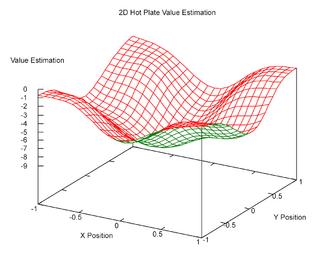
One more value function image...
Here's another version of the estimated value function for the agent in the 2D world described in the previous post. This was generated as a scalable vector graphics from from gnuplot, and I converted it to a PNG:

Subscribe to:
Posts (Atom)